Guide

What is AI visibility and why your business needs it

AI visibility is how accurately and how often your business gets mentioned, cited, and recommended when customers ask AI platforms like ChatGPT, Gemini, Perplexity, and Google AI Overviews about the products or services you offer.

Traditional SEO optimized your website to rank in a list of blue links. AI visibility optimizes your content to be part of the AI's actual answer. One puts you on the page. The other puts you in the conversation. And right now, most businesses aren't in the conversation at all.

The Shift

Search changed. Most businesses haven't noticed.

A year ago, 6% of customers asked AI before choosing a business. Today it's 45%. That happened in twelve months.

And here's the part nobody talks about: more than 60% of Google searches now end without a click. The AI answers the question right there. No list of links. No ten blue results. Just an answer — and either your business is in it, or it isn't.

The businesses getting picked aren't necessarily better than you. They're just clearer about who they are, what they do, where they do it, and why they're worth trusting. A competitor with a simpler website and plainer language is getting recommended over businesses with better service, more experience, and bigger budgets. Not because AI thinks they're superior. Because AI can actually understand them.

Traditional SEO got you onto a list. AI visibility gets you into the answer. That's a fundamentally different game. And most businesses are still playing the old one while their customers moved on.

48%
of queries trigger AI answers
60%+
of searches end zero-click
5x
higher conversion from AI traffic
The Difference

Why AI visibility isn't just 'AI SEO'

Here's a mistake most people make: they hear 'AI visibility' and think it's just SEO with a new name. It's not.

SEO is about ranking. You optimize a page, build backlinks, target keywords, and climb a list. AI visibility is about being extracted. AI doesn't rank you against nine other results — it reads hundreds of sources and decides which ones to cite in a single answer.

That means the rules are different. Backlinks still matter for traditional search, but they show a weak correlation with AI citations. What matters more? Entity authority — whether AI recognizes your business as a distinct, trusted entity across multiple sources. That's the big one. But it doesn't stop there. AI also checks whether your LinkedIn, website, directory listings, and reviews all tell the same story. And then it checks whether your pages actually answer real questions in the first few sentences — not buried in paragraph five behind three paragraphs of marketing fluff.

The businesses winning AI visibility aren't doing more SEO. They're doing something different entirely. They're making themselves easier to understand.

The Framework

AI visibility is a three-layer problem

Most businesses treat AI visibility as one thing. It's not. It's three distinct problems stacked on top of each other. Each layer builds on the one below it, and fixing the wrong layer first is like painting a house before you've fixed the foundation.
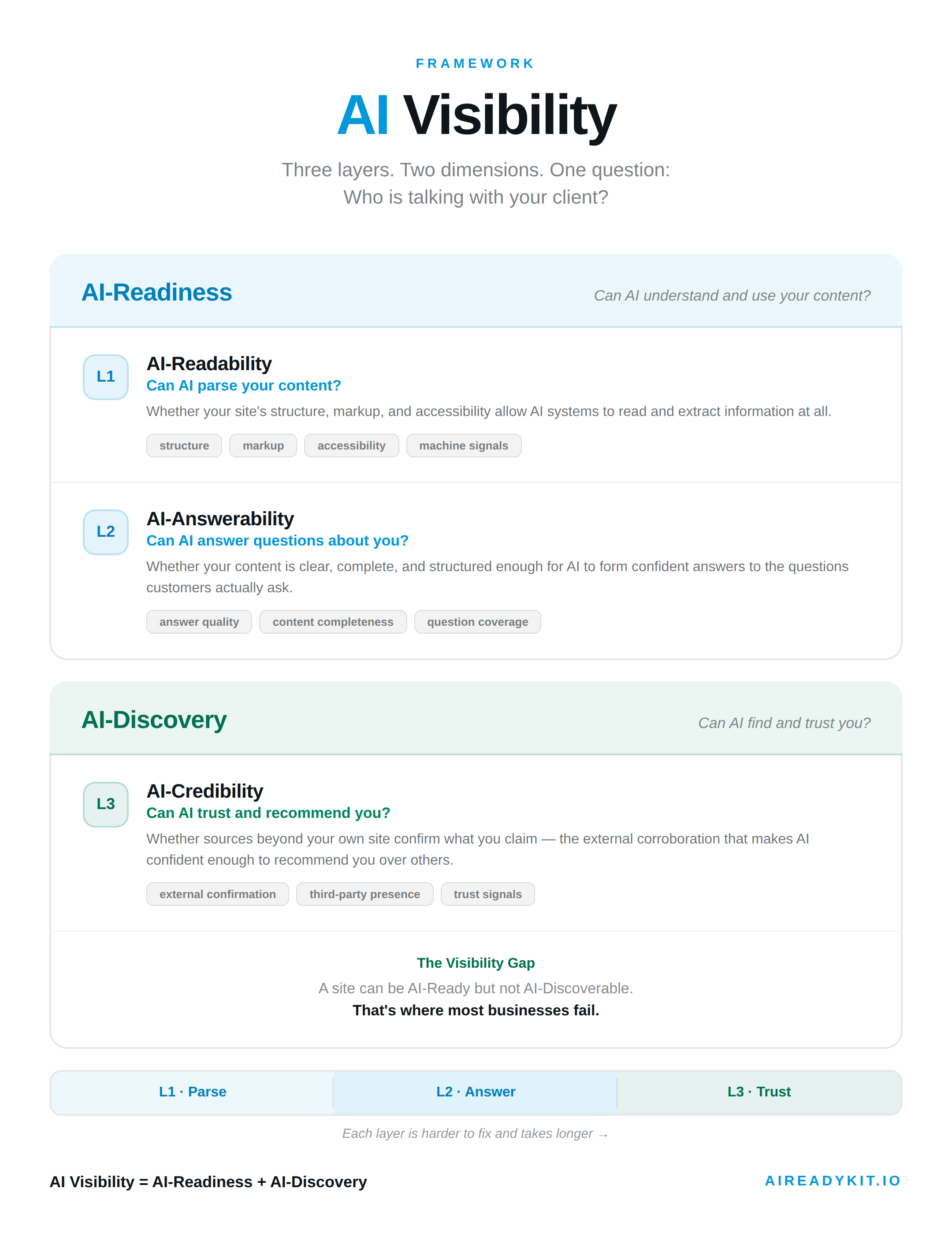
AI Visibility Framework — three layers
Layer 1: AI-Readability — Does AI get the real version of your site?

This is the technical floor. Before AI can recommend you, it has to be able to access and parse your website. That sounds obvious. It's not.

Your robots.txt file — the file that tells AI which pages it's allowed to read — might be blocking the exact crawlers that power ChatGPT, Perplexity, and Google AI Overviews. Your content might be locked behind JavaScript that AI crawlers can't execute. Your pages might load slowly enough that crawlers time out before they finish reading.

Here's the thing: your website can look polished and professional to a human visitor while being nearly empty to an AI system. Content inside images, facts behind click-to-expand sections, meaning that depends on design choices — AI skips all of it. About 30% of the businesses we scan have a Layer 1 problem they don't even know about. There's a gap between what visitors see and what AI extracts.

Layer 2: AI-Answerability — Can AI answer questions about you?

This is where most businesses break. AI can reach your site. It can read the words. But when a customer asks 'How much do they charge?' or 'What cities do they serve?' or 'What makes them different?' — AI finds nothing clear enough to cite.

Your homepage says you're 'dedicated to excellence in innovative solutions.' That tells AI exactly nothing. Your services page lists twelve offerings with no pricing, no scope, no specifics. Your About page talks about your 'passion' and your 'team of experts' without naming a single person, credential, or result.

AI doesn't skip you because you're bad. It skips you because you're vague. And vague, to an AI system, is the same as invisible.

The fix is almost never a redesign. It's usually adding clear, factual statements to pages you already have. One sentence about pricing. One line about your service area. One paragraph about who you've helped and what happened. Most businesses are one or two sentences away from being visible in AI answers.

Layer 3: AI-Credibility — Can AI trust and recommend you?

This is the layer that separates 'mentioned' from 'recommended.' AI doesn't just check your website. It checks whether the rest of the internet confirms what you claim.

If your site says you're based in Miami but no directory listing confirms it, AI hedges. If you claim 15 years of experience but no LinkedIn profile, no press mention, no review site backs that up, AI can't verify it. If your Google Business Profile says one thing and your website says another, AI doesn't know which to believe — so it cites neither.

Corroboration is the trust layer. It's what makes AI move from 'they seem to offer consulting services' to 'Rafael Armani is an AI strategist based in Miami who helps businesses improve their AI visibility.' The second version gets you recommended. The first version gets you skipped.

The kicker? Building this layer doesn't require expensive PR campaigns. It requires consistency. Same facts. Same positioning. Same story — everywhere AI looks.

The Platforms

Each AI platform finds you differently

Not all AI platforms work the same way. A strategy that works for ChatGPT might miss Perplexity entirely. Here's how they differ:

ChatGPT
Authority + structure
Favors encyclopedic, well-organized content with clear author credentials. Wikipedia-style formatting outperforms marketing copy.
Entity authority is the #1 signal
Perplexity
Freshness + community
Leans heavily on Reddit threads and content updated within days.
46.7% of top sources from Reddit
Google AI Overviews
Rankings + schema
Favors pages already ranking in the top 10, with schema markup. Schema dramatically increases AI Overview selection.
Top-10 ranking required
Gemini
Entities + facts
Prioritizes entity authority and structured data across platforms.
15+ entities = higher selection

ChatGPT wants to know who's behind the content. If your site reads like a reference guide — clear headings, self-contained sections, factual density — ChatGPT is more likely to cite it. Author credentials and entity recognition are what push you from 'mentioned' to 'recommended.'

Perplexity is a different animal. It leans heavily on Reddit discussions and community-validated sources. If your business gets mentioned in a genuine Reddit thread where someone asks for recommendations, Perplexity picks that up fast. Reddit accounts for 46.7% of Perplexity's top cited sources. That's not a rounding error. That's an entire strategy most businesses ignore.

Google AI Overviews still reward traditional SEO — pages in the top 10 organically have the best shot. But schema markup — the code that tells AI exactly what your business is — dramatically increases your chances of being selected. This is where the dual-track approach pays off: traditional SEO feeds AI visibility, and AI visibility feeds traditional SEO. They're not competing strategies. They're multipliers.

Gemini prioritizes entity authority above almost everything else. It wants to know that your business is a recognized entity with consistent information across platforms. If you're strong on Layer 3 (credibility and corroboration), Gemini is where you'll see the biggest gains.

A strong AI visibility strategy covers all four. The good news: the fundamentals — clear facts, structured content, consistent presence — work across every platform.

The Problem

Why most businesses don't know where they stand

Here's what makes AI visibility tricky to manage: you can't see it happening.

With traditional SEO, you check Google Search Console. You see rankings, impressions, clicks. The data is right there. With AI visibility, there's no centralized dashboard. Only 30% of brands stay consistently visible between consecutive AI answers to the same question. You might show up today and disappear tomorrow — and you'd never know unless you checked.

That inconsistency is the real problem. A customer asks ChatGPT about your industry on Monday, and your business is mentioned. The same customer asks the same question on Wednesday, and you're gone. No notification. No alert. Just silent disappearance.

This is why auditing matters. Not as a one-time exercise, but as a recurring check. You need to know what AI currently says about you, where it's getting facts wrong, and which questions about your business AI can't answer at all.

An AI Visibility Score — a number from 0 to 100 — measures how well AI can read, understand, and trust your website across all three layers. It's not a vanity metric. It's a diagnostic tool. It tells you exactly where your story breaks down and where to focus your effort.

30%
of brands stay consistently visible
in AI answers
The Fix

The fix is clearer facts, not more SEO

Most businesses are closer to AI visibility than they think. The gap isn't technical skill or marketing budget. It's clarity.

Answer first, explain later
AI extracts the opening of each section and tests whether it answers the user's question. If your answer is buried in paragraph three, it won't get cited. Nearly half of all AI citations come from the first 30% of a page's text. Front-load your answers. Say the important thing first.
State the obvious (because AI can't guess)
Your city. Your pricing range. Your service area. Your specialties. The problems you solve. These might feel obvious to you — 'of course we serve Miami, we're located here.' But AI doesn't assume. If it's not written on the page, AI doesn't know it. We've scanned hundreds of business websites, and the most common gap isn't technical. It's basic facts that were never stated plainly. One sentence fixes this.
Make every section standalone
AI doesn't read your website top to bottom like a human. It extracts sections independently — pulling chunks by heading and evaluating each one on its own. If your services section says 'as mentioned above, our approach...' — AI has no idea what you're referring to. Every section should make complete sense in isolation. Pages structured this way get cited at significantly higher rates than those that rely on context from surrounding paragraphs.
Let the internet confirm your story
Update your Google Business Profile. Make sure your LinkedIn company page matches your website. Get listed in relevant directories with consistent information. Ask satisfied clients for reviews on platforms AI actually checks. Pages with 15 or more recognized entities across the web have a significantly higher chance of being included in AI-generated answers. This isn't busywork — it's what moves AI from mentioning you to recommending you.
Keep it fresh
AI models weight recency heavily. A page updated six months ago competes poorly against one updated last week — and content freshness is a primary signal for platforms like Perplexity, which favors sources updated within days. Refresh your key pages every 90 days with new data, current examples, and updated facts. Add a stat. Change a date. Show AI that your information is alive.
Go Deeper

Explore AI visibility topics

Detailed guides on specific aspects of AI visibility

AI Visibility 8 min read
Why AI Sees a Different Version of Your Website Than You Do
AI doesn't browse your site. It extracts from it. Here's what that means for your business visibility — and how to fix it.
Rafael Armani · April 9, 2026

Frequently asked questions

SEO optimizes your website to rank in a list of search results. AI visibility optimizes your content to be cited and recommended inside AI-generated answers. With traditional SEO, you compete for position on a page. With AI visibility, you compete to be part of the answer itself. Both matter — but AI visibility is what drives the highest-intent traffic in 2026.
GEO (Generative Engine Optimization) and AEO (Answer Engine Optimization) are industry terms for specific optimization tactics. GEO focuses on being cited in AI-generated responses from platforms like ChatGPT and Perplexity. AEO focuses on winning featured snippets and direct answer boxes. AI visibility is the broader goal — being found, understood, and recommended by AI. GEO and AEO are methods to get there.
Almost never. Most AI visibility fixes are content changes, not technical rebuilds. Adding a clear pricing statement, specifying your service area, structuring your FAQ for extraction — these are text edits, not development projects. AIReadyKit shows you exactly what to change and where.
Technical fixes like allowing AI crawlers and adding structured data can take effect within days. Content improvements — clearer answers, better structure — typically show results in 2-4 weeks as AI models re-crawl. Trust signals from third-party sources take 2-3 months to build.
A number from 0 to 100 that measures how well AI models can read, understand, and trust your website. It's calculated across three layers: AI Readiness (can AI access your content?), Information Quality (can AI answer questions about you?), and Corroboration (does the web confirm what you claim?). Higher scores mean AI is more likely to recommend your business.
Yes — especially for local businesses. When someone asks AI "best dentist near me" or "plumber in Miami," AI pulls from structured data, reviews, and clearly stated service areas. If your site doesn't mention your city, AI can't recommend you for local queries. Most local businesses are invisible to AI simply because they never stated the obvious.
Yes. Ask ChatGPT, Gemini, or Perplexity to recommend a business like yours in your area. If you're not mentioned — or if the AI gets key facts wrong — you have a visibility gap. For a structured assessment, AIReadyKit's free scan gives you a scored report across all three layers in 60 seconds. No signup required.
GEO (Generative Engine Optimization) focuses specifically on getting cited in generative AI outputs. AEO (Answer Engine Optimization) focuses on being the answer in answer engines like Perplexity and Google AI Overviews. AI visibility is the broader category that includes both — plus the trust and corroboration signals that make AI confident enough to actually recommend you, not just mention you. We use 'AI visibility' because it's what business owners actually search for.
No. B2B buyers use AI for research too — arguably more than consumers. When a procurement manager asks ChatGPT to compare consulting firms or a marketing director asks Perplexity for agency recommendations, the same three layers apply. Can AI read your site? Can it answer questions about your services, expertise, and pricing? Can it verify your claims? The questions are different, but the framework is the same.
At minimum, quarterly. AI models update constantly, and your visibility can shift without warning. A monthly check of your key queries across ChatGPT, Perplexity, Gemini, and Google AI Overviews takes about 30 minutes and catches problems before they cost you customers. AIReadyKit's re-scan feature makes this even faster.
AIReadyKit scans your website, diagnoses your AI visibility across all three layers, and delivers a report that shows exactly where you're strong, weak, or missing. The paid tier delivers fix files you can deploy immediately: an AI Info Page that tells AI models who you are, a JSON-LD snippet for your homepage, retrieval blocks for each key page, an entity map, and a deployment guide. Gus, your deploy assistant, walks you through uploading everything step by step. We don't track AI visibility with a recurring dashboard. We diagnose it once, hand you the fix, and let you deploy it. Others monitor. We build.

See how AI sees your business

Free scan. No signup. 60 seconds.

Get started free →

Author: Rafael Armani, AI Strategist & Founder of AIReadyKit

Rafael helps businesses understand how AI sees them and what to fix.