A year ago, 6% of consumers used AI for local business recommendations. Today it’s 45%.
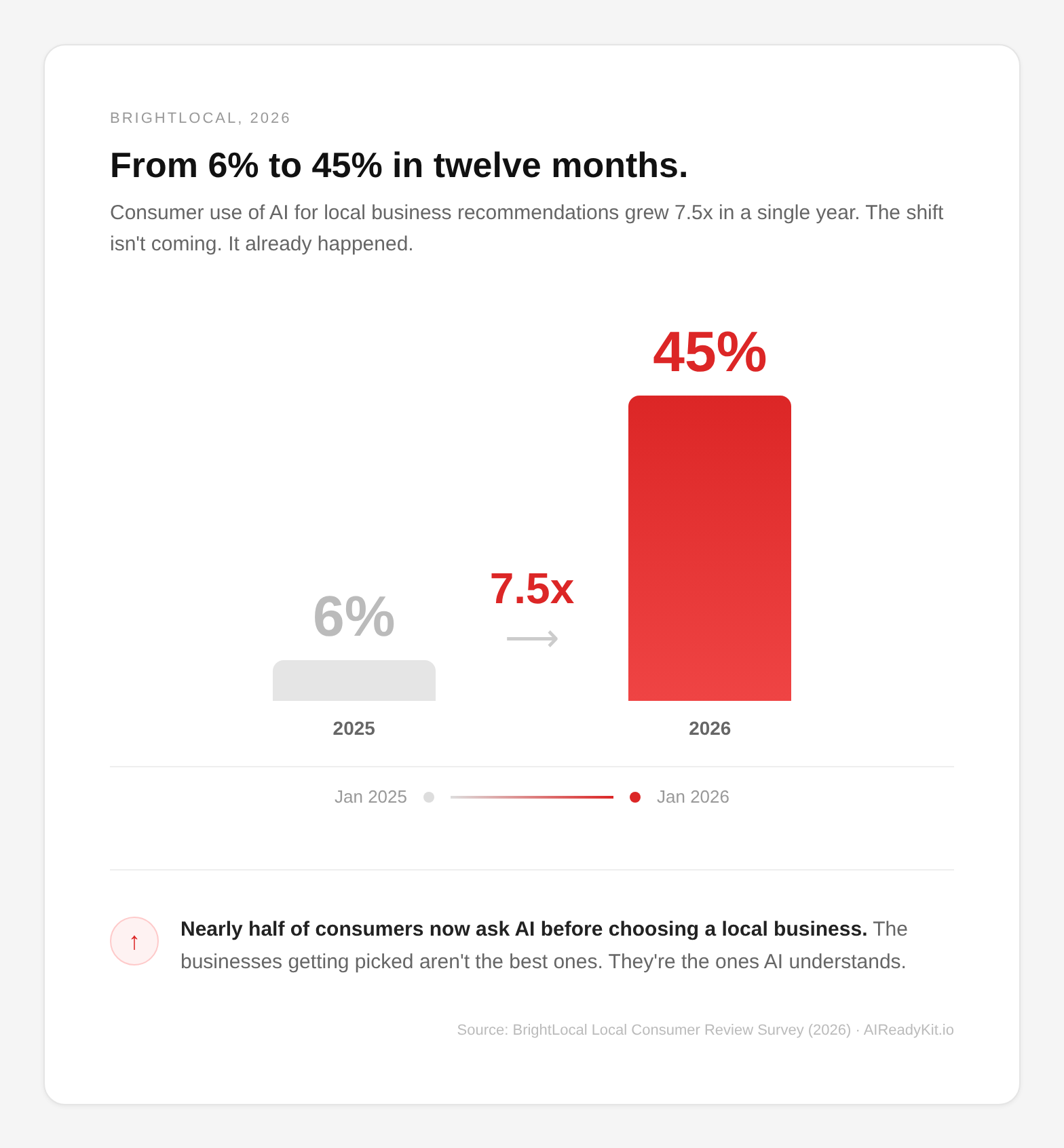
Twelve months.
And the businesses getting picked aren’t the best ones. They’re the ones AI understands.
Most owners have no idea this is happening. You check your Google rankings, look at traffic, maybe run some ads. Normal stuff. Meanwhile a growing chunk of your customers are typing into ChatGPT or Perplexity or Google’s AI Overviews: “Who should I hire for X in my city?”
The answer comes back with someone else’s name.
Not because they’re better. Because AI could read their site and couldn’t read yours.
The paper that rewired how I see this problem
In March 2026, Google DeepMind published a paper called “AI Agent Traps.” The security world was talking about hackers. I got my eye somewhere else.
DeepMind names something called “detection asymmetry.” Meaning: the AI agent has no way to know that what it saw on your site was different from what a human would’ve seen.
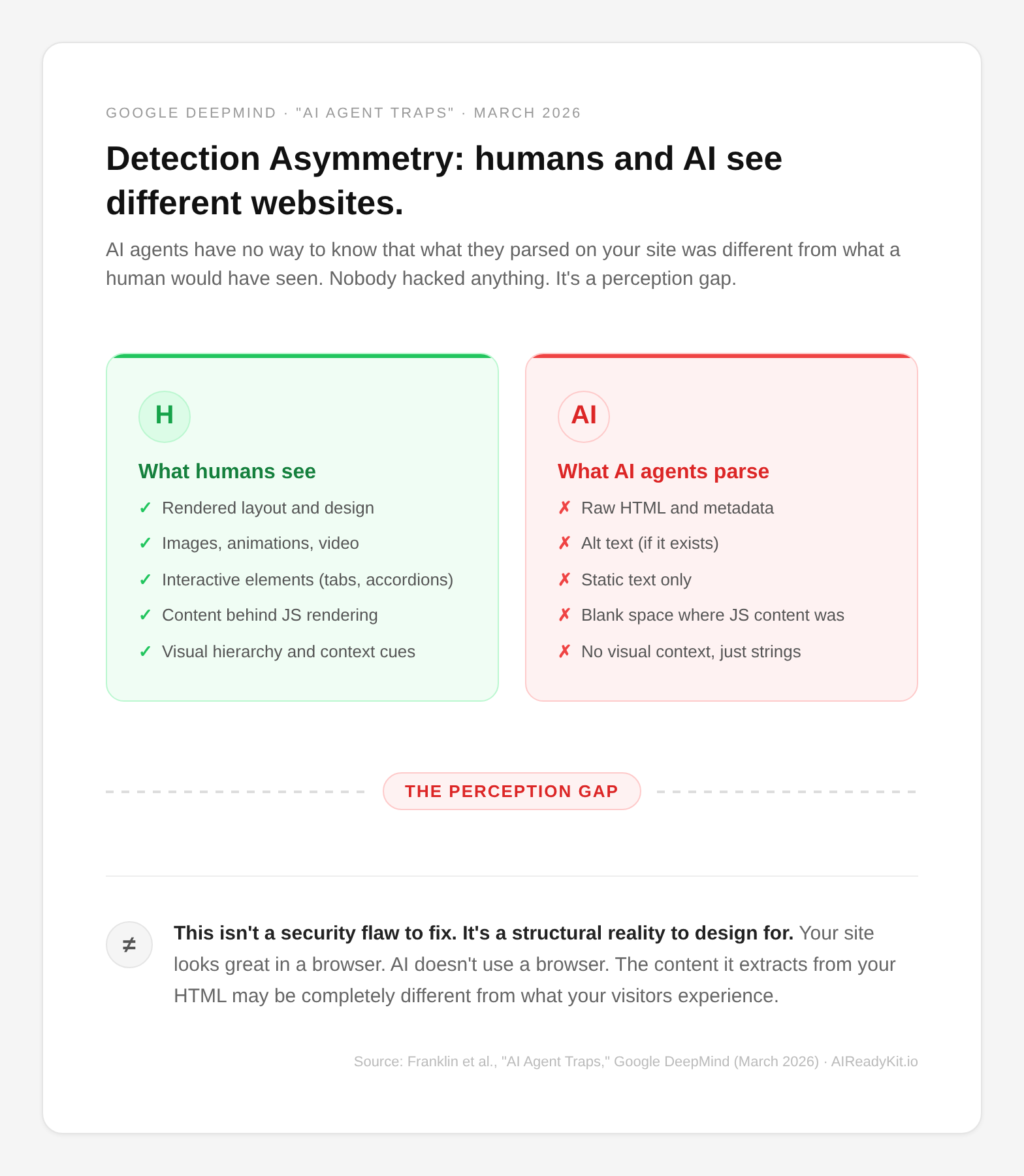
Nobody hacked your site. Nobody planted malicious code. It’s just a gap in perception that nobody designed on purpose, and nobody’s fixing on purpose either.
That concept matters way beyond cybersecurity. It’s already playing out on your website right now.
The Three Stages of AI Invisibility
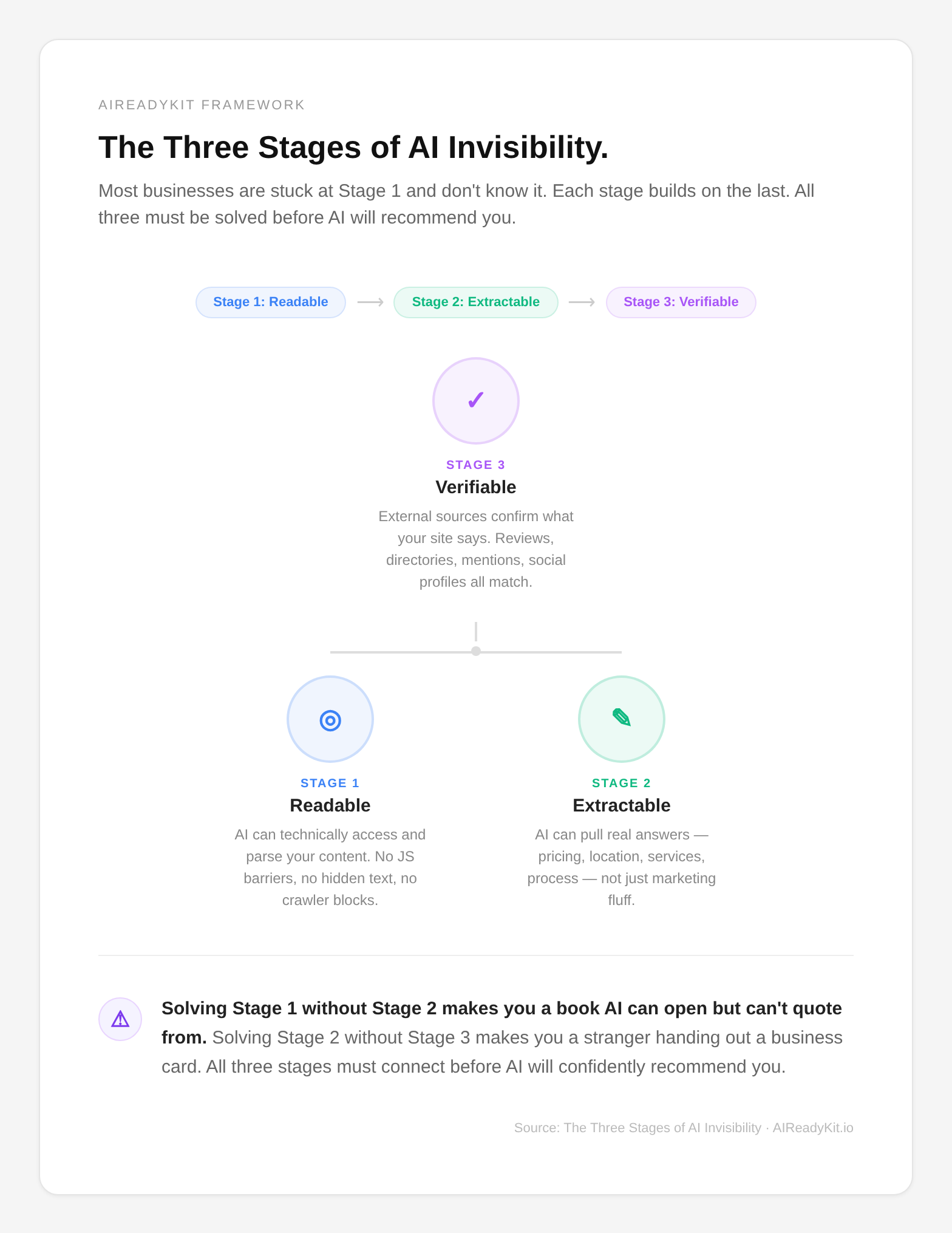
I’ve been auditing AI visibility across hundreds of sites through AIReadyKit. Same pattern shows up every time, three stages, stacked. Each builds on the last. Most businesses are stuck at the first one and don’t know it.
Stage 1: AI can’t read you
Most common problem. Most invisible.
Your site looks great in a browser. Clients love it. But AI agents don’t use browsers the way humans do. JavaScript components that need rendering. Pricing tables built as images. FAQ sections inside accordions that stay closed for bots. Navigation that only shows up after you click something. Content stuck behind cookie consent walls.
A 2024 Vercel study tested every major AI crawler, OpenAI’s, Anthropic’s, Meta’s, Perplexity’s, and found none of them could render JavaScript.
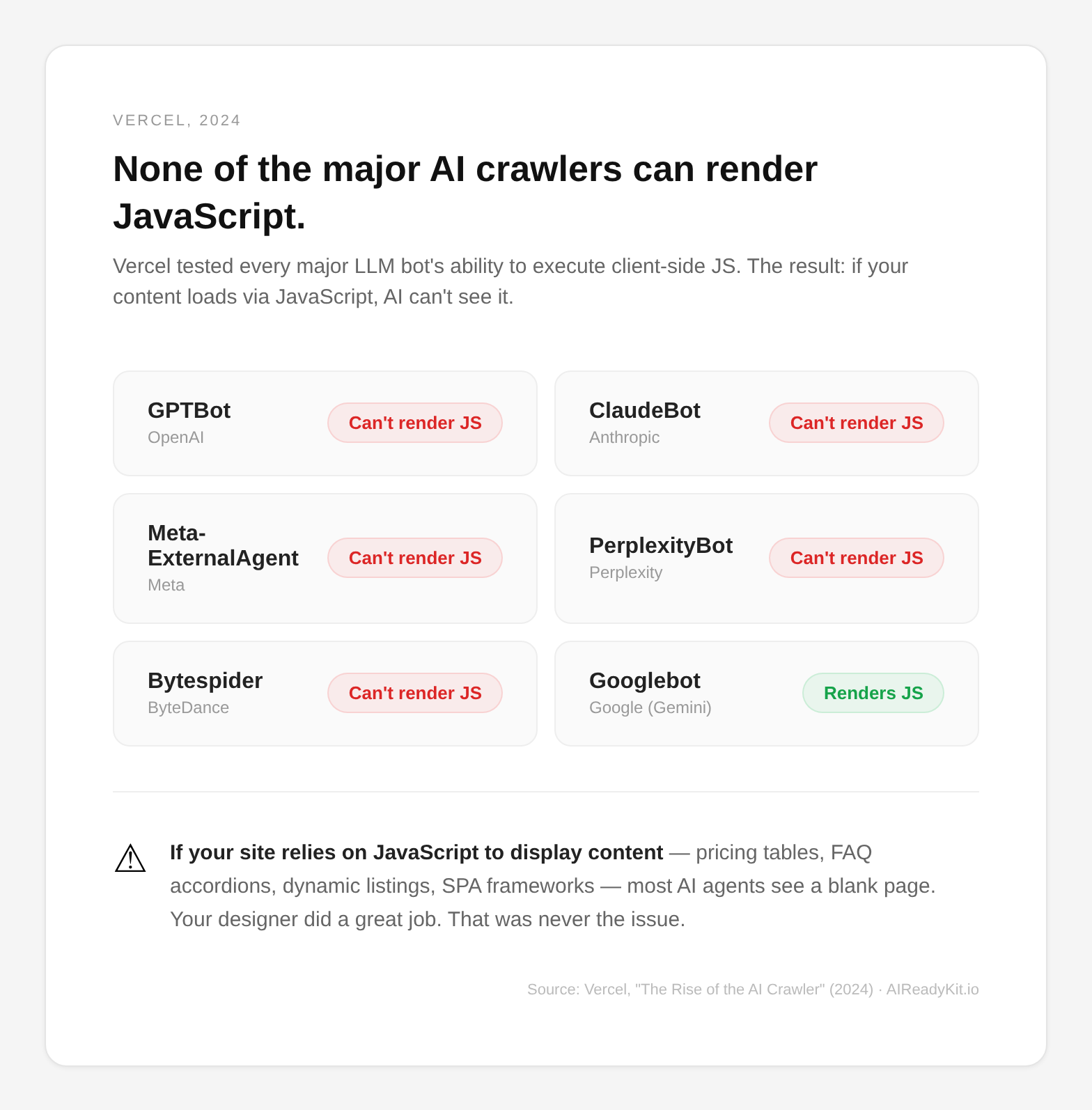
Your designer did a great job. That was never the issue.
This is the stage most people think about when they hear “AI visibility.” Fix the technical stuff, let AI in, done. Right?
No.
Stage 2: AI can read you but can’t answer about you
This is where it gets interesting, because this is where most businesses actually fail. And have zero clue.
Content’s there. AI can hit every page. Text loads fine. Now try asking AI a real question about the business.
“How much do they charge?” Nothing. “Where do they operate?” Nothing. “What’s their process for working with clients?” Nothing.
The copy says “We help businesses grow.” It says “Our team is passionate about delivering results.” It says “Contact us for a custom quote.”
For a human browsing, that works fine. Sits next to photos and design and layout. The visitor fills in gaps from context clues.
AI doesn’t fill in gaps.
AI reads text and tries to pull out facts. When the facts aren’t there, it doesn’t say “I don’t know about this business.” It just recommends someone else. No notification, no warning. You don’t exist in that conversation and you’ll never find out it happened.
Among consumers who use AI tools, 63% already trust AI-generated business recommendations, according to BrightLocal’s 2026 research — and 23% make decisions based solely on what AI tells them, without checking further. The businesses getting those recommendations have the clearest facts on their pages. Not the best design. Not the most traffic.
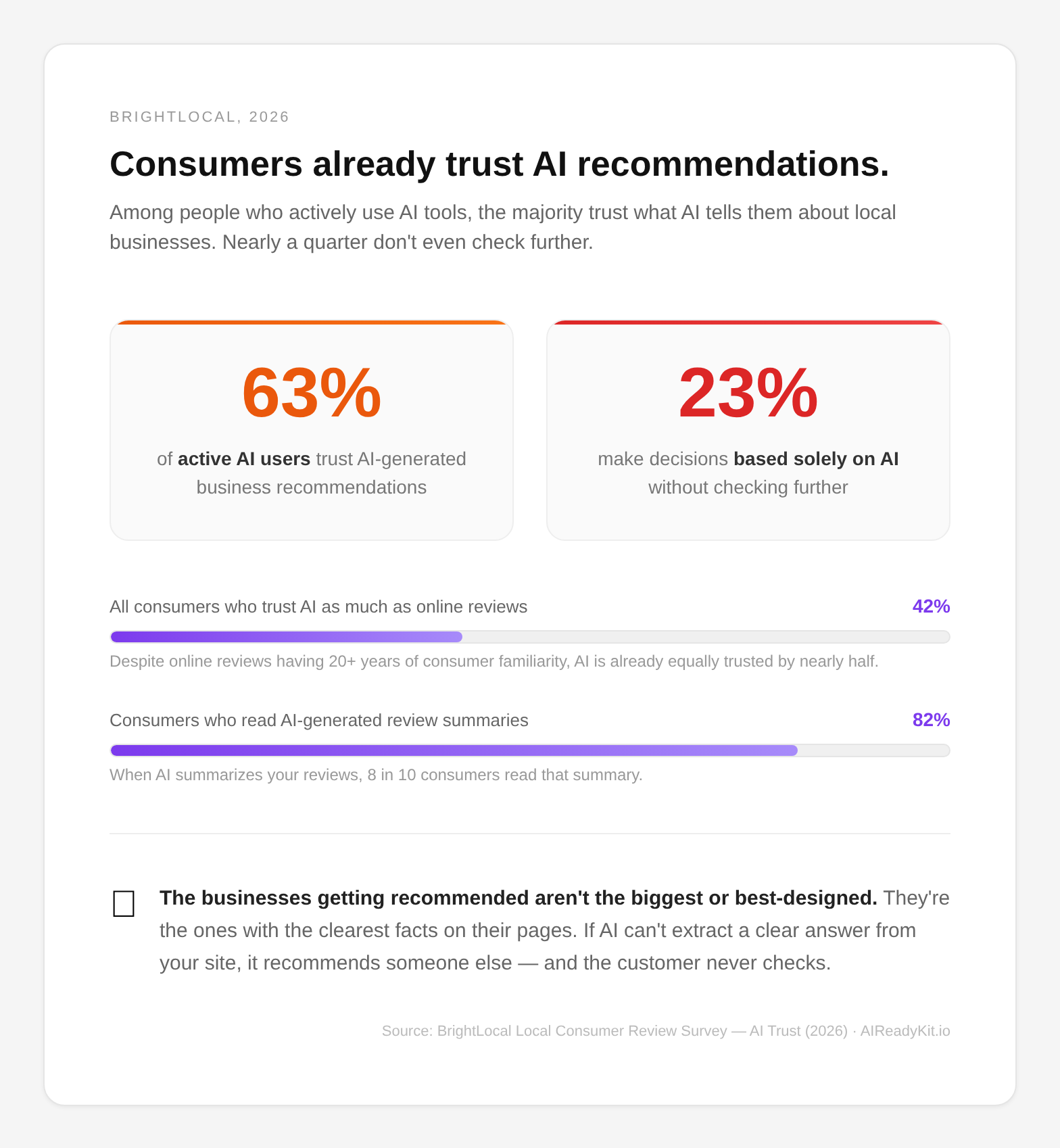
The clearest answers.
If you’ve solved stage one but not stage two, you’re a book AI can open but can’t quote from.
Stage 3: AI can answer but won’t recommend
Nobody sees this one coming.
Say your site is readable. The content has real information, pricing, location, services, process. AI can describe your business accurately.
It still won’t recommend you.
This is where AI works differently from Google. Google ranks pages. AI recommends businesses. And when AI recommends, it does something Google never really did — it goes and checks your homework. Reviews on Google and Yelp. Directory listings. Mentions in articles. Social profiles that match what the site says.
If your website says one thing and nothing else on the internet confirms it, AI treats you the way you’d treat a stranger handing you a business card at a conference. Polite. But you’re not telling your friend to call them.
SE Ranking’s 2025 study of 129,000 domains found that businesses with a presence on review platforms like G2, Trustpilot, and Yelp were 3x more likely to be cited by ChatGPT. Businesses with significant presence on community platforms like Reddit and Quora? 4x more likely.
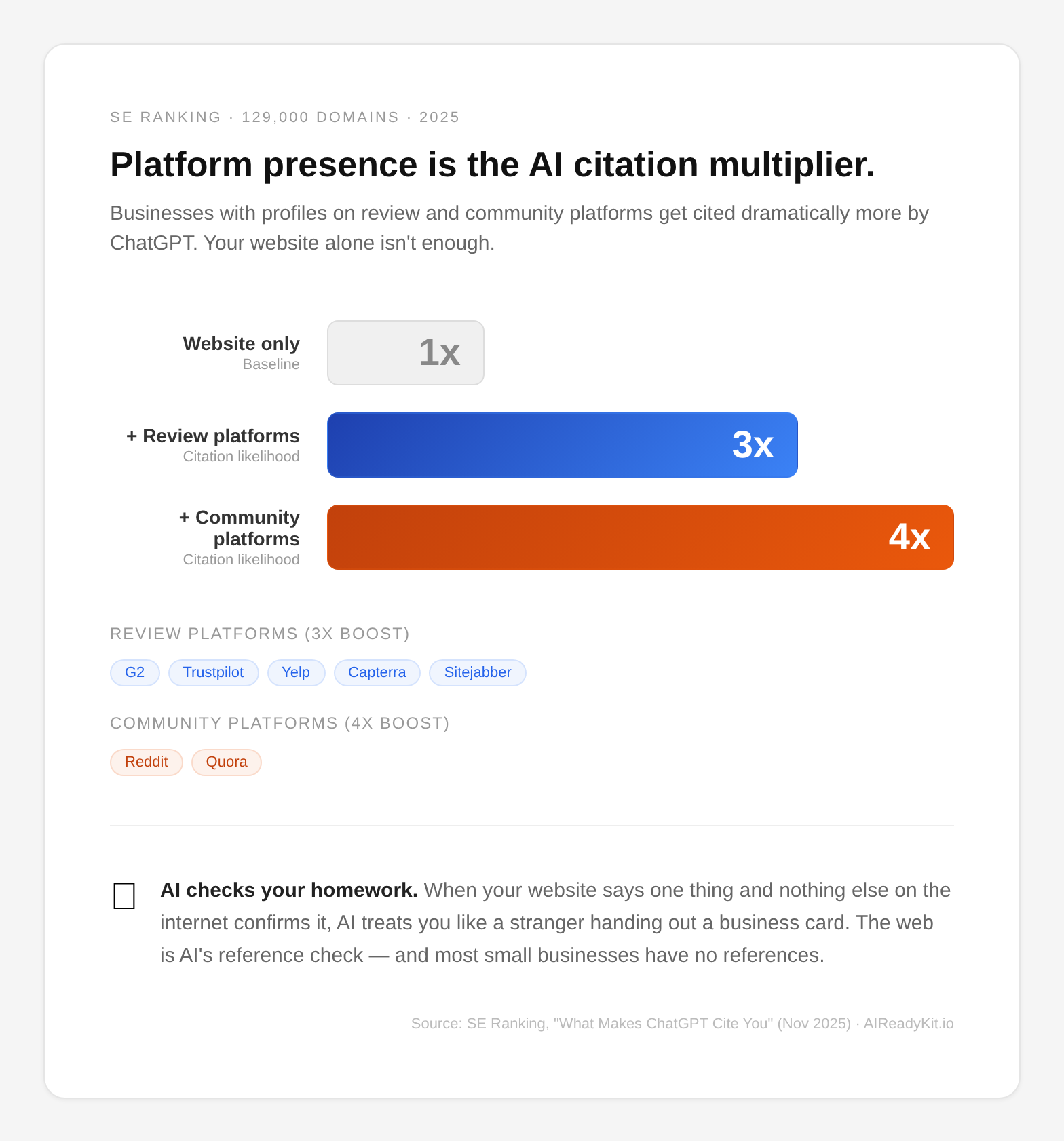
The web is AI’s reference check. And most small businesses have no references.
Here’s the twist — this isn’t a tech problem
Three stages. Technical requirements. External sources. Sounds like another thing you need to hire someone for.
Simpler than that.
The real shift isn’t technical, it’s editorial. Most business websites were written for humans who browse. Humans who look at pictures, scan layouts, absorb design cues. The copy was built to create a feeling. Not to answer a question.
AI doesn’t browse. It extracts.
And that one sentence changes what “good content” means for every business with a website.
The fix is embarrassingly simple
Almost every fix comes down to one thing: say the obvious. Say it clearly and say it early, in plain text on the page.
You know your pricing? Put it in a sentence on your services page. You know your city? Put it on every page, not just the contact page. You know what makes you different from competitors? Write it down in plain words instead of burying it behind “we’re passionate about excellence.”
44.2% of all LLM citations come from the first 30% of a page’s text. Your answer isn’t in the first two sentences of a section? AI skips it.
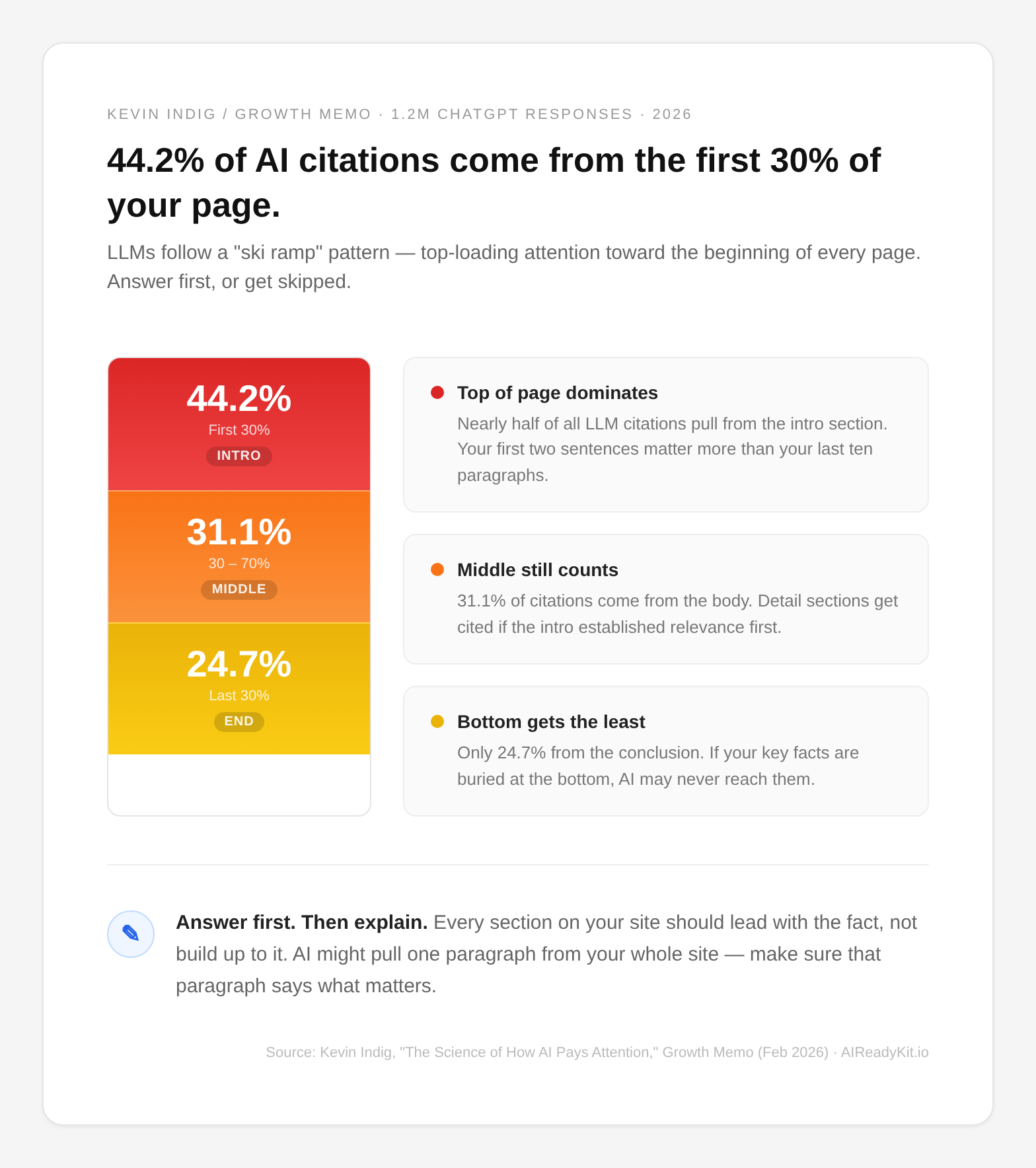
So answer first. Then explain. Not the other way around.
Every section on your site should stand alone. AI might pull one paragraph from your whole site to answer a stranger’s question. If that paragraph says “as we mentioned above,” it’s useless out of context.
And facts beat feelings, every time. I know that’s not what your copywriter wants to hear but it’s what the data keeps showing.
“Competitive pricing” means nothing to AI. “$150/hour, projects starting from $2,000” — means everything.
“Serving clients nationwide” — vague. “Based in Miami, FL, working with clients across the US and Latin America” — specific enough to cite.
That’s it. Not a new technology. Not a six-month project. Just say what you know, clearly, where AI can find it.
What’s actually at stake here
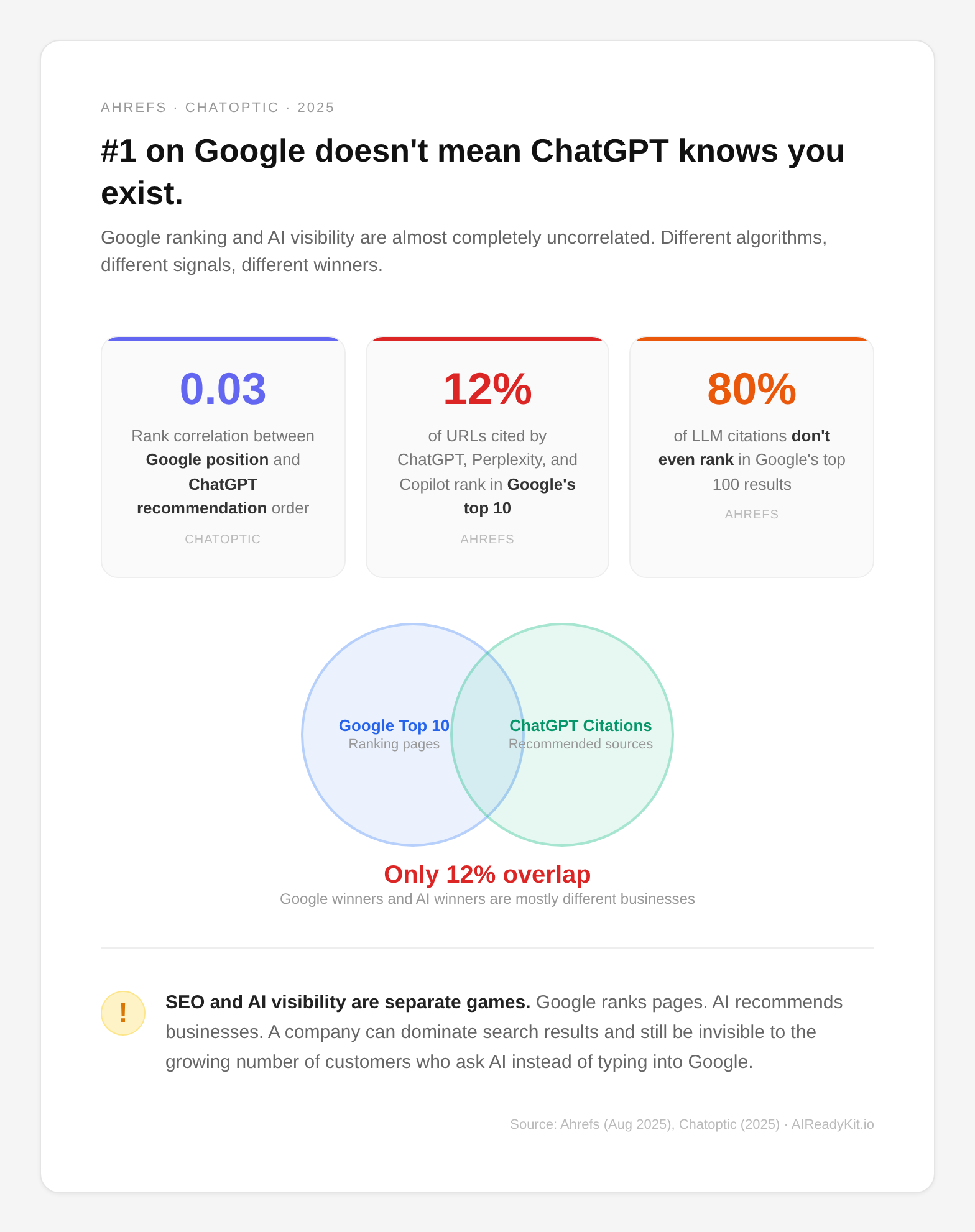
This isn’t SEO. Traditional SEO optimizes for Google’s ranking algorithm. AI visibility works differently. AI doesn’t rank you on a list. It decides whether to mention you at all. And if it does mention you, how confidently.
A business can rank number one on Google and still be invisible to ChatGPT. A business with a modest site but strong reviews and consistent presence across trusted platforms can get recommended over competitors with far more traffic.
The businesses that win the next five years aren’t the ones spending the most on ads or publishing the most blog posts. They’re the ones whose story is so clear that AI has no choice but to tell it right.
AI doesn’t see your design. It reads your words.
Right now, most businesses haven’t given it very good words to work with.
Try it right now
Takes thirty seconds.
Open ChatGPT, Perplexity, Gemini, or Claude. Type “score my website (your website) for AI visibility.”
Read what comes back.
That answer is the version of your story AI is telling people today. If it’s wrong, incomplete, or just not there — now you know why.
And now you know where to start.